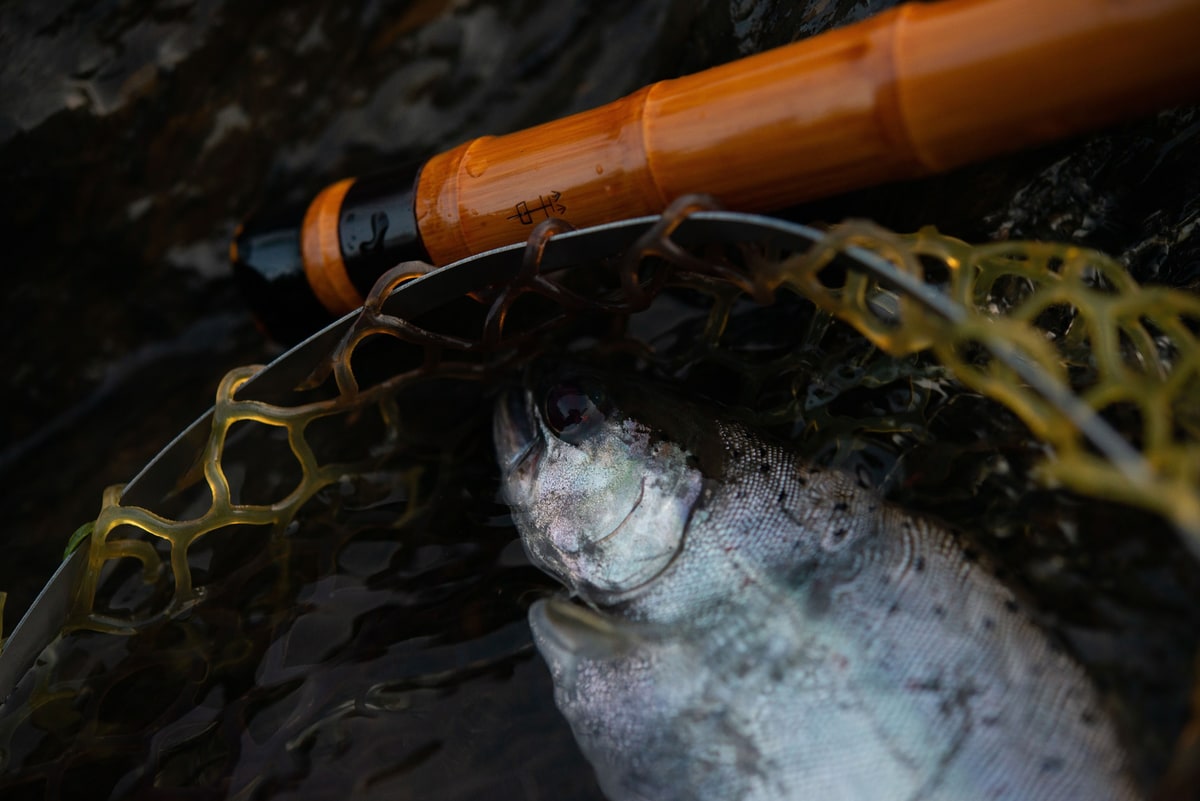
Season opens. The party that missed the start
As the mountain-stream season opens, social timelines begin to fill. The "rusted" trout — the dark-flanked individuals lifted from fields where snowmelt still lingers — line up day after day. The members of WAZAO-IPPON (hereafter, Saoichi) at that time, however, were running east and west, passing right past the streams. They were like a maglev train, vaulting over many crucial water sources to hurry to a destination.
Beginning in January, a rush of weddings among members. The first in-person booth at "Tsuri Fes 2023" at Pacifico Yokohama. (The dates collided with one of the weddings, and the team plunged into panic.) Inspections of the Nagoya and Osaka tackle shows. The casting wazao field tests on Ishigaki Island and Miyako Island, and visits to local egi workshops. The Izu trip we made to meet the spring squid. (No squid.) Booth exhibition at "Masuou," the area-trout event run by Lure Magazine in Hamamatsu.
"Ah. Chuzenji Lake has opened." On the way back, empty-handed, from Nikko, we noticed: the season had quietly turned to full spring.
Around that time, a chat came in from Tomoka Furutani, the head of Nihon Kusaki Research Institute (hereafter, Kusaki).
"Right then — let's go river fishing in Kyoto." — Yes.
"On May 8, in Kyoto, I'll be serving a meal made with local plants. I'm looking for a fish to fit it." — Yes.
And so, announcing the opening of this season's mountain stream for us, a new mission begins.
Carrying the golden cycle of "shake" to Kusaki's plate
What river fish would suit Kusaki's plate? Amago? Iwana? Ayu was out of season.
This mission, it seemed, did not end at simply offering a river fish as "fine ingredient." What was being asked for was a fish that Saoichi could provide — one that would do something for Kusaki.
In the first place, I have felt that Kusaki's work has a kinship with Saoichi's.
Taking the nature of Japan as the subject, reading the regional climate and culture that surround it. Editing the discoveries made there, and aiming to offer them as new value.
Where Kusaki's subject is, literally, the plants and trees of Japan, Saoichi's subject is the fishing of Japan. The distance is short. To be clear: Kusaki is a great elder, far ahead of us. Even so, I had felt that the two could fill in for each other in some places. For Saoichi, this was also a stage on which to prove that.
Looked at this way, it was hard to be satisfied with simply a stream fish. The market has supply networks for wild fish. Farmed fish, refined for taste, can also be bought. Above all, there was no felt necessity that it be us. We needed a fish with more meaning as expression.
— Shake (salmon).
— The relay of life carried by the shake should be set on Kusaki's plate.
(*In this article, for convenience, "shake" refers to those fish of the salmon order, salmon family living in Japan that descend to sea and ascend rivers.)
Born in the streams, traveling to the sea and growing, returning. Among the shake there are individuals who descend to the ocean (the sea-run form) and individuals who finish their lives in the stream (the landlocked form). Their roots are the same, yet their appearances differ entirely. According to one account, those defeated in territorial disputes in the streams are the ones who descend to the sea. The former losers, having gone "global," return with sharpened faces and bodies polished by the journey — a romance that one can take, almost, as a hint of life. They are that kind of fish.
After roughly three years abroad, they ascend their birth rivers at the cost of their lives, spawn, and end their own. The bodies that die there bring not only descendants, but also a precious source of protein and ocean-derived nutrients to the mountain. These give moisture to the forest's ecosystems and soils. From that, the next generation of mountain is raised. Yes — the shake raises the mountains of Japan.
Shake, set on Kusaki's plate. That itself becomes the expression of the mountain's cycle. When the last piece — the shake — connects with Kusaki, on the plate an endless rotation begins, and the golden shine of nature is released.
From the above, we decided that the target species would be the shake. And we would do it with a Japanese bamboo rod.
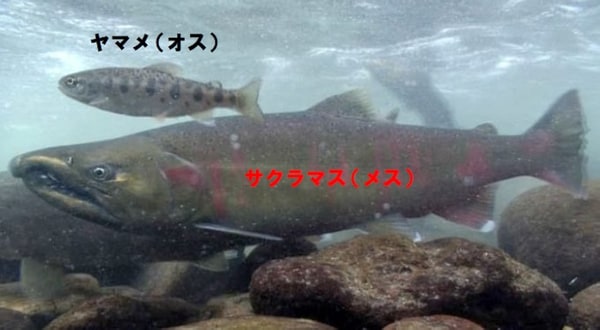
The fish to chase: the Nagara River satsukimasu
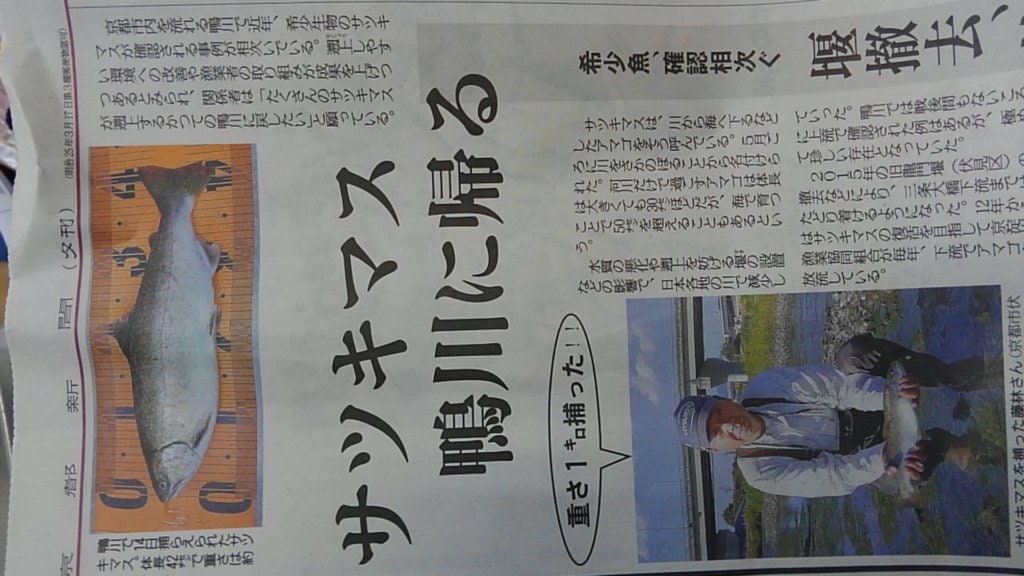
In the Pacific-side Kinki area, when we say shake, there is essentially one choice: the satsukimasu, the sea-run form of amago. Satsukimasu have greatly diminished in number in our day. To our surprise, however, there are also satsukimasu in the Kamo River. The Kyoto Kamogawa Fisheries Cooperative is leading the way, releasing amago and installing fish ladders. In recent years, satsukimasu have begun to be confirmed there. (Remarkable.)
On the other hand, hardly any actual angling reports turn up. As we dug deeper, we learned that the local Joushuya tackle shop holds something called the "Second Satsukimasu Derby." Asking by phone — "Both the first and second derbies, zero catches." The few individuals confirmed so far are thought to be released fish that descended toward the river mouth and returned, and have not yet reached spawning. The shop staff said they have seen one specimen brought into the shop, just once.
The Kamo River satsukimasu is a legend in the very moment of its return. But for now, it has not yet reached the natural cycle. Hoping, one day, that the satsukimasu rotation will return to the Kamo, this time we chose Gifu's Nagara River — known as the "sacred ground of satsukimasu" — as our field. Looking at the Nagara, too, the writing dances with phrases like "lucky to land one in a year." Either way, the satsukimasu is a legendary fish.
For the trip, taking into account how long preserved freshness lasts, we decided on ten days. "As soon as we land one, we'll cross Kyoto's Sanjo Ohashi bridge holding the satsukimasu high above our heads." With this promise to Furutani-san in place, we made our preparations to head out.
An aside: as far as I know, the only Kamo River satsukimasu angling article in print appears in Walton magazine, vol. 10. I think it is a major scoop.
Another mission
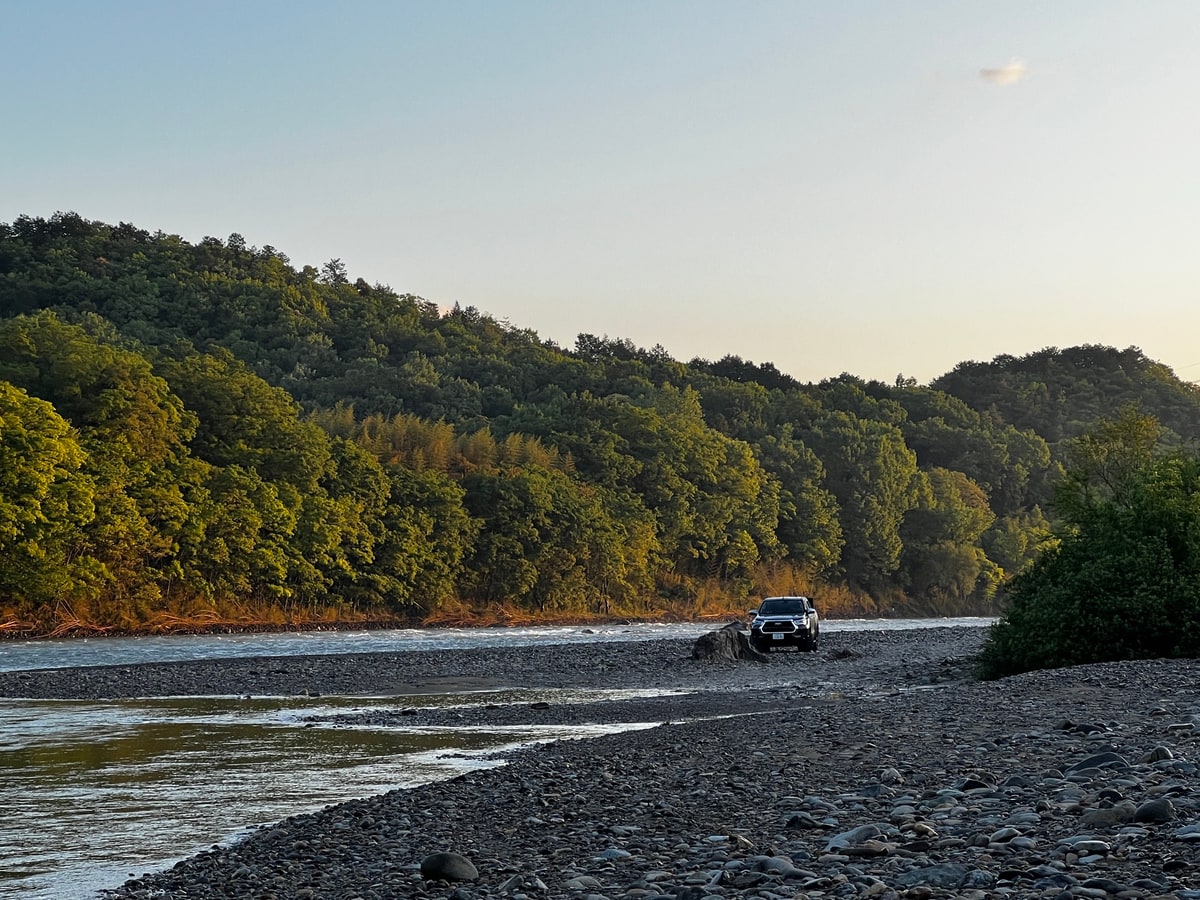
The night of April 26. Pushing every tool we could think of into the bed of the Toyota Hilux, we left the Gakugei-daigaku office where we are usually based. For this trip, Soeno and Muramoto would handle the field. As it happened, in the same period, a major event was approaching for our member Kato: having a new baby. A child was about to be born. The satsukimasu expedition and the due date overlapped exactly. To prepare for any change in his wife's condition, Kato would stay home. Praying for the success of two missions, both of unbearable weight, at once, he drew on his characteristic sense to find a single goal that could integrate the project.
— If we catch a satsukimasu, the boy's name will be Satsuki.
In that moment, two entirely separate events were redefined onto a single process. As a shared goal, a slogan was born for the team: "Make the boy's name Satsuki." For that, we would catch the satsukimasu, and answer Furutani-san's expectations. The wife would deliver the child, with mother and child both well. And beyond all of that, the boy would be named Satsuki. So that this single mission, beautifully reconfigured, would succeed, each of us scattered to our posts with our breath full.
All Kato himself could do was pray. He only had to pray for one thing now: that the boy's name would become Satsuki.
Loaded with everything, the car heads west
Running the Tomei expressway late at night. Heavy trucks bound by tight schedules pin the accelerator to the floor. The Hilux runs through the gaps between them, gaps shorter than even autonomous driving would manage, while keeping its shoulders low. And yet — proudly, more proudly than any other vehicle on the road.
A sense of expectation toward a new field, the Nagara River. The happiness of being able to take part in the story of life that the shake has woven. The hot will to contribute to the plate Kusaki is making. The thoughts entrusted to us by the members left behind. And the right to name a child of the future. The car, packed full of all of these, runs almost without rest, and arrives at the Nagara just past 3 a.m.
— to be continued in part 2 —