Once the middle of March is past, the air at the water's edge plainly changes. The angle of the light shifts and the surface of the river begins to shine white. When that happens I think: it is nearly time.
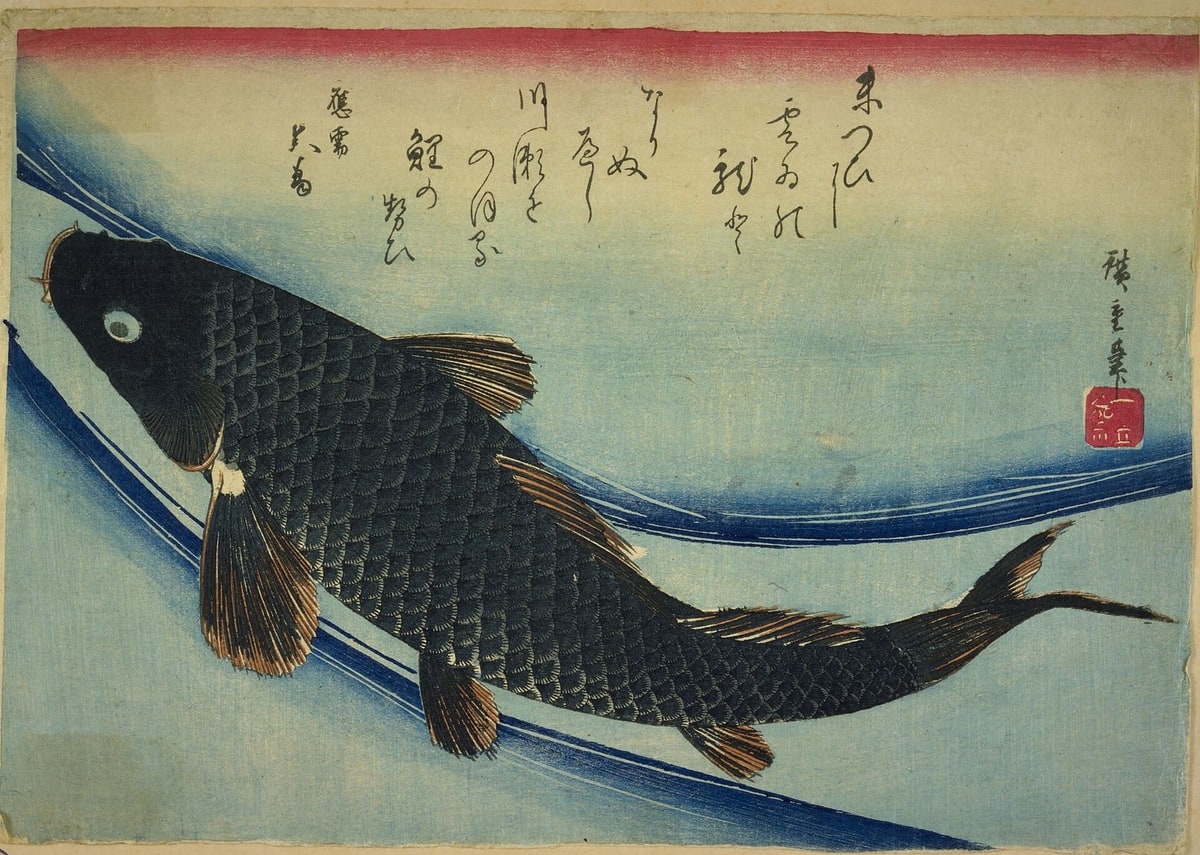
Utagawa Hiroshige / National Diet Library (public domain)
By the calendar it is past the waking of insects, when the creatures under the soil are said to crawl out, but in my case it is not insects that come first; it is the fish on the bottom that I cannot get out of my head. Why this should be I find odd myself, but it happens every year, and I have given up on it.
The Spawning Run
The crucian come up into the shallows. This is called the run. Fish that have wintered in deep water move to the reeds and the weed beds to spawn. The crucian of this season is called the run crucian, and it is a season word of spring. A female with roe in her is round and heavy, so heavy you would not take her for the same fish.
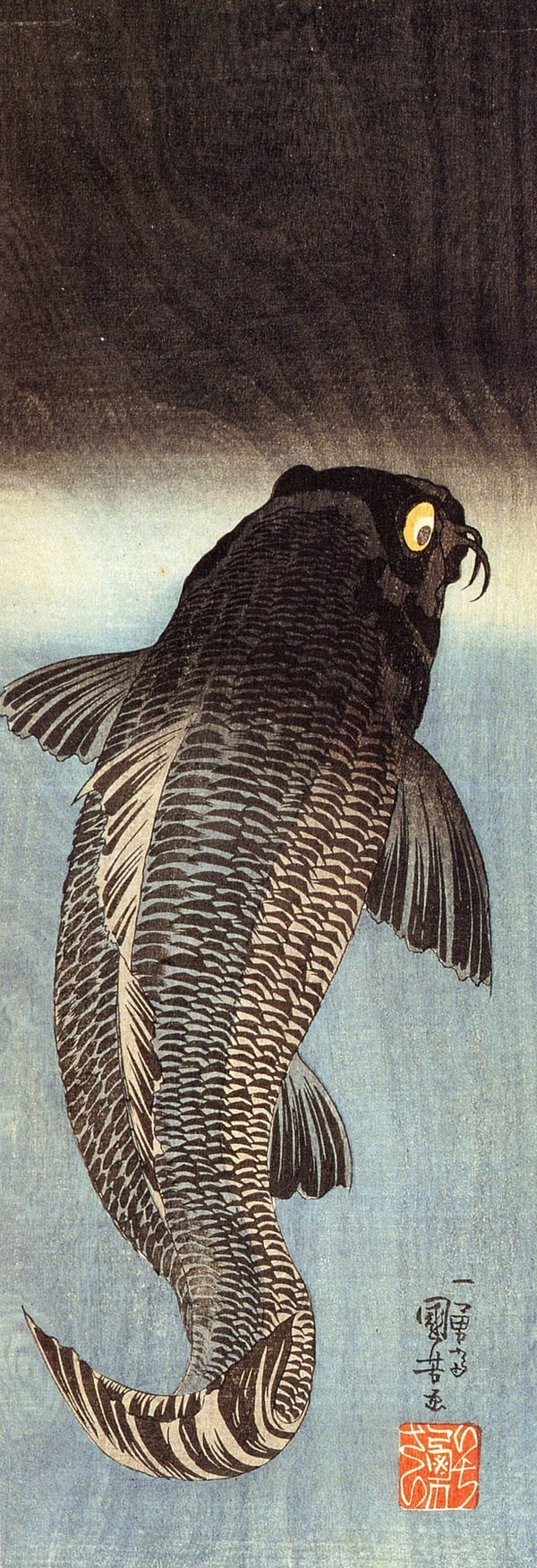
Utagawa Kuniyoshi (public domain)
For the anglers of Edo, the crucian was the fish that opened the year. Crucian in spring, sillago and ayu in summer, goby and mullet in autumn, tanago to close the winter. Such was an Edo angler's calendar, and its first page was the spring run of crucian. To begin a year without taking a crucian leaves one somehow uneasy. I have felt that unease myself.
The Line of the Rod Makers
Something should be said about the rods those anglers held. In 1723 a specialist book on fishing was compiled by a certain bannerman. It is held to be the oldest surviving fishing book in Japan; the first volume treats the waters, the second the tackle and bait, the third the seasons and the weather, and it already sets out how to choose a jointed rod. Which is to say that the craft of joining bamboo had by then been organised as a samurai pastime. Jointed rods themselves are older: a haiku book of the Enpo era, early in the Edo period, already carries the name of the nested rod, in the Kyoto region. The craft began in Kyoto and came into flower in Edo — that appears to be the broad line of it.
Development in Edo begins with Taijiya Tosaku, who set up a rod shop in front of Kotoku-ji in Ueno in 1788, the eighth year of Tenmei. He is the first of the line of Edo bamboo rods that continues today. Tosaku had been a samurai of the Kishu Tokugawa house on duty in Edo. For a samurai to begin making rods and open a shop is a considerable turn to take, though if he liked fishing there is no helping it.
From Tosaku's line came Saochu, Saoji, Saotatsu and other makers, who made rods separately for each fish: crucian rods, tanago rods, goby rods, sillago rods. Changing the rod with the fish was the Edo angler's way, and it was held to be the taste of the thing. Crucian rods are built from hoteichiku and yadake joined together. Dealing with run crucian wants strength in the waist, and yet the tip must be fine. Answering contradictory demands of that kind was the rod maker's work.
In 1936, when the Russian-born opera singer Chaliapin came to Japan, he visited Tosaku in Ginza, called the fourth-generation master the Stradivari of rod makers, and said that in Japan fishing itself might be an art. To put out a rod on Lake Kasumigaura in spring with a rod that made a Russian opera singer say as much — that seems to me quite enough. Whether anything is caught is another matter.
Spring at Kasumigaura
Around the fifth of April comes the clear and bright season, when all things are said to look clean and lit. About then, in the ditches of Kasumigaura and the Tone system, the dead water plants begin to stir and rustle. The fish are moving in there.
The run at Kasumigaura opens along the north shore of the western lake and, as the air warms, the fishing moves slowly northward. Grain rain falls about the nineteenth of April, and around then it is drawing to a close. Every year I think I must go before the cherry drops, and every year I notice the blossom has already gone to leaf.
The Tackle
The tackle is a single fixed-line rod. Nylon of one as a standard for the main line, a little finer when the water is clear. The rig is a searching one, with five small floats threaded along it, so that it can be swung in at a good tempo.
The old anglers' tackle was not so grand either, it seems. A jointed rod of two and a half ken, the line cut to about six feet, three white floats of three bu threaded on, and a shell sinker pinched on. That was the standard rig for run crucian, and one worked along the edge, at the foot of the reeds where the shoots are coming up prettily. In water where a good fish might show, the line was silk of one rin and the absorbency of silk was used. Unlike nylon, silk takes up water and settles, so it beds into the water and rides the current naturally. I have never yet made up a silk rig myself. I have come along years without doing it.
For bait, the earthworm is best. The run crucian feeds hard on animal food and seems unable to resist the particular movement and smell of a worm. Paste will take fish, but in this season it is worms and nothing else. The old anglers were particular about the kind, and the standard was the kiji worm. In early spring, when the cold comes back, they used aquatic larvae — bloodworm, akabo, botta — and in some districts there were fine points of practice, such as that two or three small kiji, finer than a botta, hooked lightly together, would draw better. Anglers everywhere are oddly particular about bait.
What most affects the crucian is the movement of water. When water runs and the level comes up, the fish feed hard and start for the shallows. The day after a warm spring rain, with a moderate colour in the water, is as good as it gets. The old anglers called such a state a bamboo-leaf colour on a muddy run — meaning, presumably, a stain you could just see a bamboo leaf through. A clear afternoon with the temperature up and the water moving. This does not change from year to year, and like the crucian I am drawn out to the water by that same mildness.
The Method
The way of it is not to sit in one place but to walk and search. They have always said that crucian are caught with the legs. There is an old angler's recollection of walking ten ri in a day by the map, which is a feat I could not manage with my legs. Even so one walks. The point is to work the places slightly deeper than their surroundings: around the dead weed, near the drains that run to the fields. Let the rig down gently, and if nothing comes, move on. Unless your attention is on that first instant after it goes down, you find the bait gone. One notices, at the water, how much of the time one's attention is not on it. Perhaps that is no different at home.
The bite shows as the float drawing smoothly under. That is the typical form with a modern searching rig. With the old ball-float rig, they say, the float sinks and then comes wavering back up. Listening quietly with the rod tip, a soft, welling weight comes through. That is a form I would like to feel once. Either way, a light lift meets something solid, and a run female, heavy in the belly, runs well for it. Take your eye off her and she is into the reed roots. After being wound into the reeds several times I began telling myself not to. Telling oneself, I have also learned, does not make it come out right every time.
The old anglers, it seems, were great keepers of fishing journals. Keeping no ordinary diary but a careful fishing journal was the way of it. I have read that they made even their companions record the weather, the tide, the hour, the boatman, the guide, the fee and the catch. Writing this account, I take it for a fishing journal of the present kind. To read it back some years on and think that one should have done otherwise is, they say, part of an angler's pleasure. I have not yet the years for it, but I suppose it will come.
After the Grain Rains
Once grain rain is past, the light takes on a hint of summer. The horsetails at the water finish growing and wild rocambole and mugwort begin to cover the banks instead. The sense of fish thins out little by little, and the crucian go back to the deep.
The next you will meet them is autumn, and then they are all very small, the size that sits in a palm. Anglers call them persimmon seeds and put out a rod again without tiring of it. And in the course of that, a year has somehow gone by.