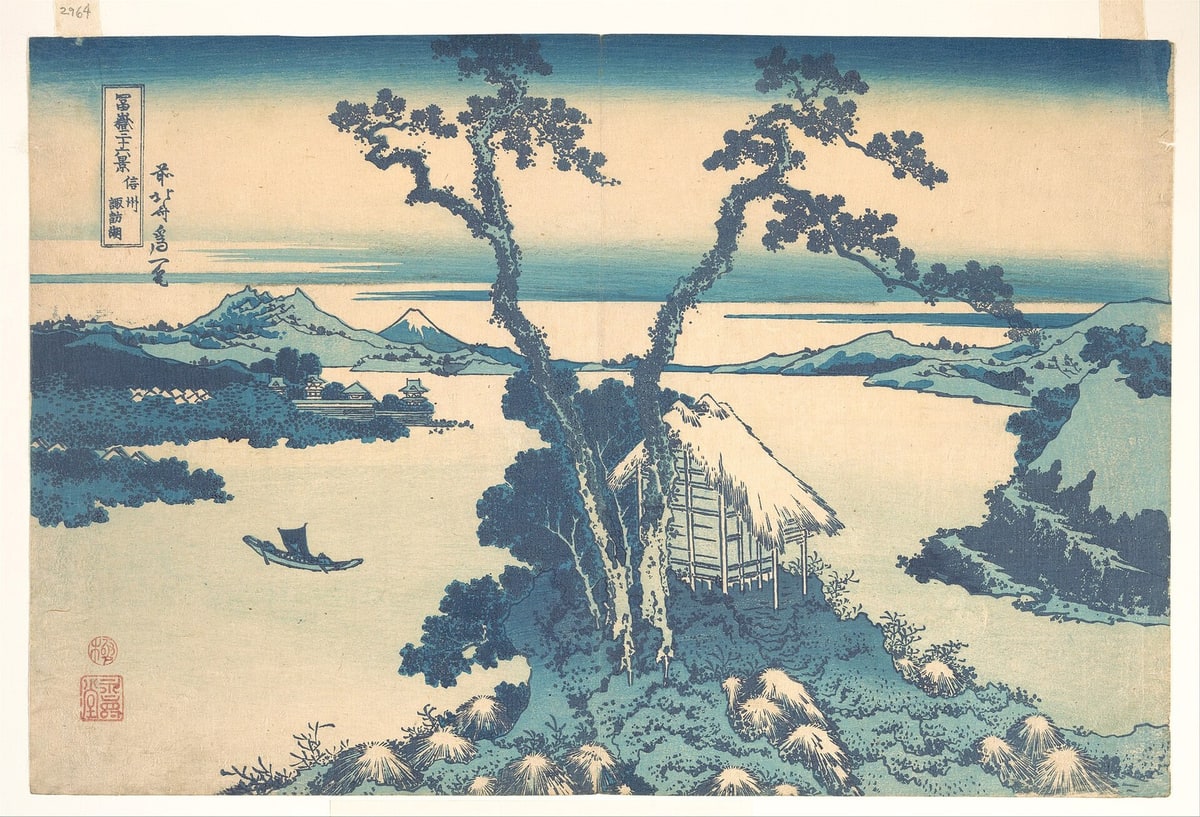
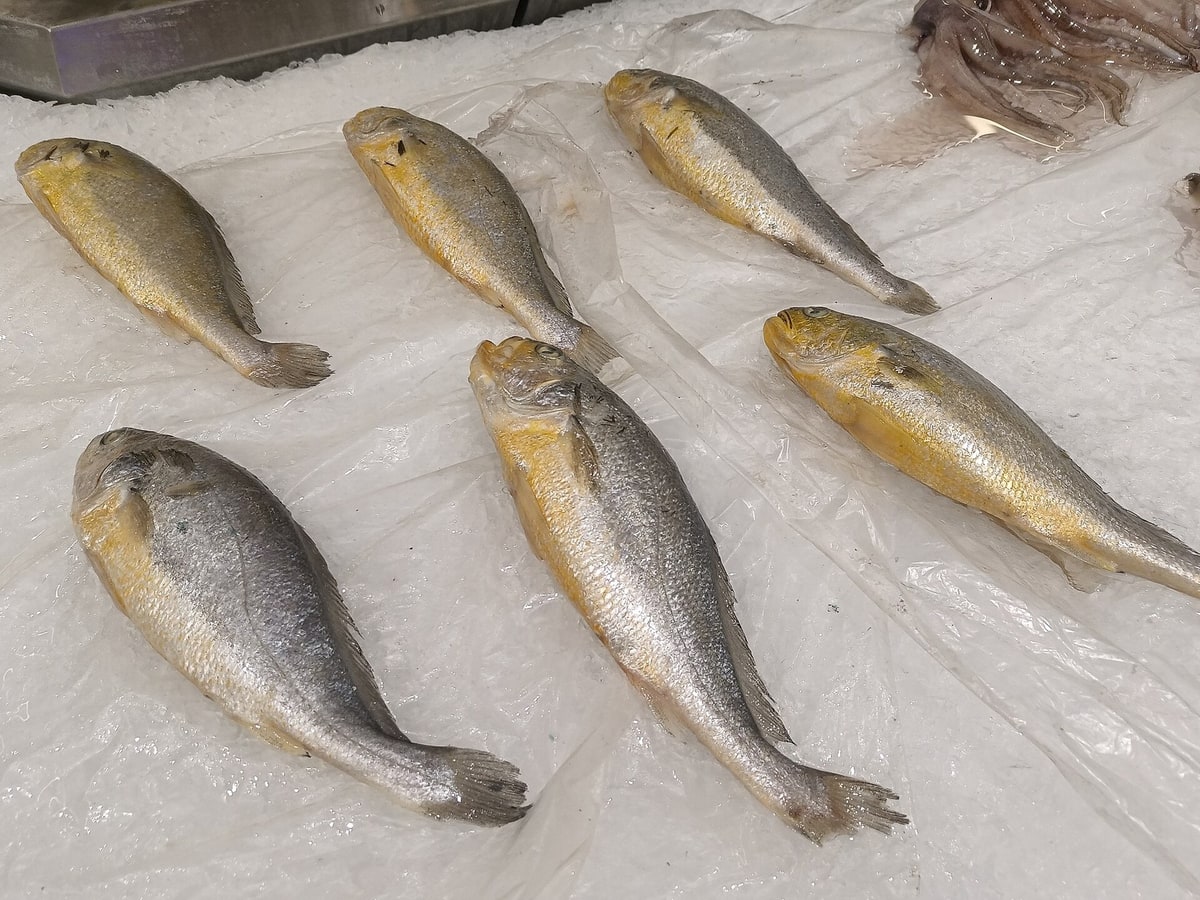
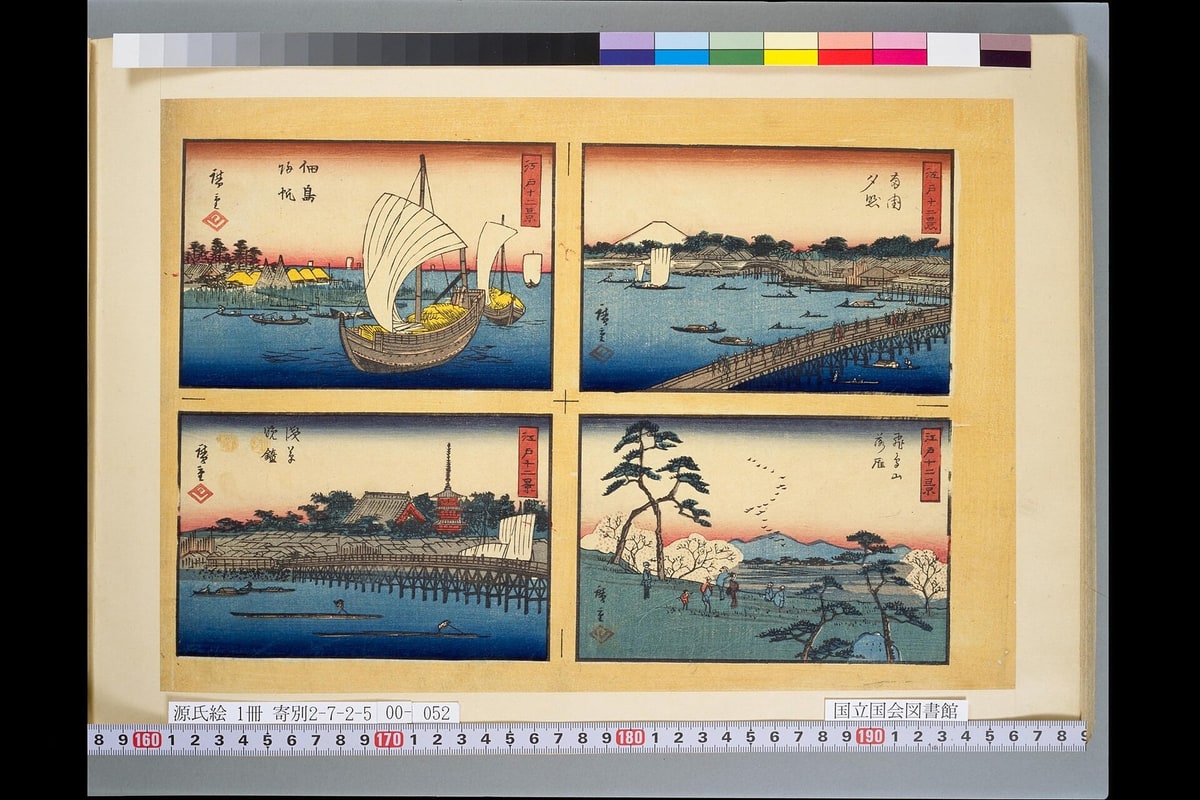
I took it into my head to go fishing once a month for a year, after the fish of each season. The idea was mine alone and nobody asked me for it. Nobody else is inconvenienced by its absence either. That I should nonetheless set out dutifully every month, and write about it besides, strikes even me as an eccentric way to spend a year. If it is eccentricity, there is no help for it.
The rough measure is one trip a month and three pieces of writing attached to it. The first is about the fish of that month, the method, and where both came from; that one can be written at a desk. The second is the record of actually going out and catching something. The third is about stopping at a house in that district afterwards and eating. Repeat that twelve times and it comes to thirty-six pieces a year. Thirty-six sounds a great many when one says it aloud, but reckoned as three a month, something written once every ten days, it is not so much. That is a little less often than I hum to myself, so it will not be impossible, I have decided on my own authority.
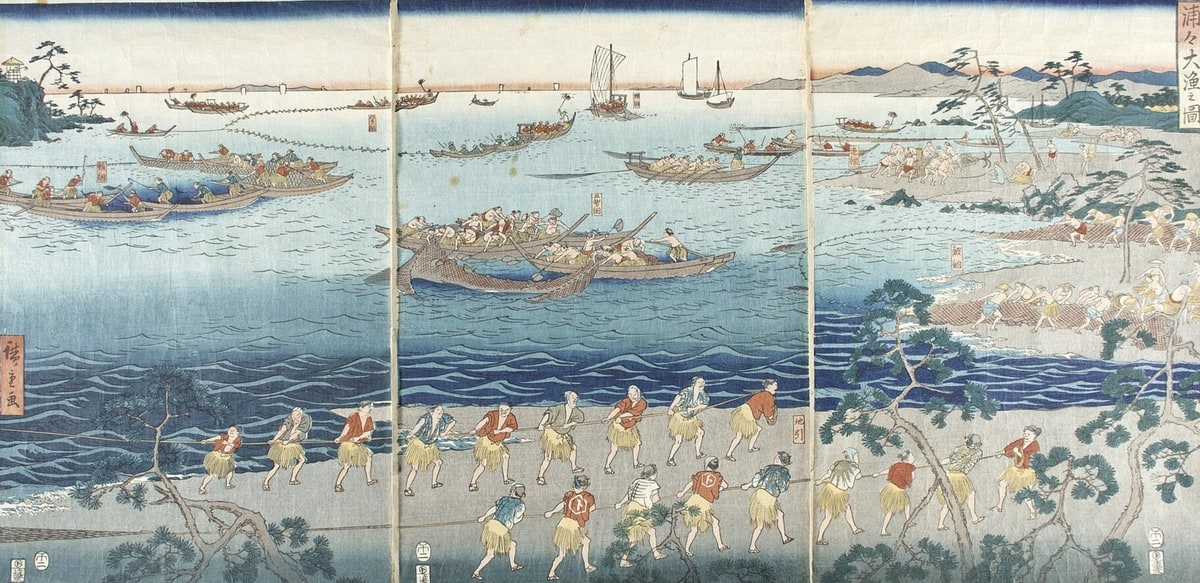
Utagawa Hiroshige / Los Angeles County Museum of Art (public domain)
Season, Fish and People
Japan has four seasons, and it has sea and rivers and lakes. In each season there are particular fish and particular ways of taking them. This seems obvious enough, but to someone who does not fish it is apparently not obvious at all.
A fish does not stay in the same place wearing the same face all year. In the spring streams the yamame come out into the runs with the snowmelt; in lakes and ponds the crucian come in to the reed edges heavy with roe. In early summer the ayu run up the rivers, and at the height of summer the sillago gather on the shoreline. Come autumn the goby drop into deep water, the kanehira puts on its nuptial colours, and the salmon return to the northern rivers. In the frozen lakes of winter the pond smelt crowd under the ice, and at the entrance of the cold the bitterling shoal in the deeper parts of the small streams.
The angler moves to keep them company. In spring he goes up into the valleys and puts out a rod at the reed edge of a lake. In early summer he stands in the run of a river after ayu. In summer he walks the shoreline and goes after prawns in the waterways at night. In autumn he searches the deeps and waits at the river for fish coming up. In winter he sets a hut on the ice and ties knots with frozen fingers. When the fish move, the people move. This linkage, in which season and fish and human movement are tied together, is what this series calls seasonal fishing.
The anglers of Edo had gathered that linkage into a single system, the fishing calendar. Spawning crucian and black sea bream in spring; blue kisu and ayu in early summer; sillago and freshwater prawns at the height of summer; goby and mullet in autumn; bitterling at the entrance of winter; pond smelt at the depth of the cold. Set a year out vertically and each of the twelve months has one quarry assigned to it. To suit that quarry the rod makers of Edo built rods for each species: crucian rods, bitterling rods, goby rods, kisu rods. The bamboo, the length and the action all differ. In each month the angler took the rod for that month and went to that month's river or sea. Home again, he ate the fish. Crucian rinsed in cold water in spring, ayu grilled with salt in early summer, sillago tempura at the height of summer, autumn horse mackerel chopped fine, pond smelt in sweet soy in winter, goby tsukudani. The cooking too answers to the season. From catching to eating, one continuous set of gestures was built into the calendar.
Most of that linkage has now been lost. The fishing grounds of the Edo front have gone under reclamation, the people who use bamboo rods have grown few, and the habit of dressing one's own catch at home is thinning. Fishing of the kind where a stepladder is stood in the shallows for blue kisu can no longer be seen in the flesh. That is no reason to stop at lamenting. Rather than grieve for what is gone, writing about what remains and what can still be done suits my temperament better. Besides, the seasons still come round every year, and the fish are still alive, though they have moved. Widen the ground to the whole country and the frame of the fishing calendar will serve perfectly well.
What This Series Does
The destinations are not confined to the Edo front. A frozen lake in January, Edo small-fish angling in February, a spring shoreline in March, the spawning run at Kasumigaura in April, a riverside platform in Kyoto in May, the shore of Lake Biwa in October, a river in the north in November. Each district has different fish, different methods, different things to eat. That it is interesting to set the differences side by side is something I noticed only recently. If that is called noticing late, so it is; people who notice such things early probably do not go fishing at all.
A word about the rods. The intention is to fish with bamboo rods as far as possible. Whether the lineage of rods the Edo makers built species by species is of any use in the hands of an angler as clumsy as I am, I rather doubt; but use aside, I want to hold them once. In a month whose quarry cannot be taken on a bamboo rod, I mean to write instead about how that month's method was carried on in the bamboo era. Whether I can write it is another matter; at any rate I shall write.
As for the details of rigs, I have settled on setting the modern arrangement of nylon line and plastic float beside the older arrangement of silk and ball float, as far as I can. Set side by side, one notices that tackle has advanced surprisingly little. Or perhaps it looks as though it advanced when in fact it simply went off in another direction. That I do not yet understand, so I will think about it again after following the twelve months through.
Something must be said about the food. A piece that only tells of cooking one's own catch does not somehow come to a close. In the country around a fishing ground there are things that can be eaten only there, and mostly they are served at a house. Having fished, one eats something nearby and goes home. That is what I write. I am not good at cooking, and not good at fishing either, so a piece about being fed at a house will make better reading than a piece about my own cooking. That too is only my own decision, without evidence.
A Map of the Twelve Months
The fish and waters of the twelve months are as follows. The basis of the choosing is a fish for which fishing in that district in that month has a seasonal meaning: the kanehira and zenitanago are placed in autumn when the nuptial colours come, and the ayu in early summer just after the season opens, so that the life of the fish and the calendar of the fishing lie on top of each other.
| Month | Fish | Chief waters |
|---|---|---|
| January | Pond smelt | Lakes of Shinshu and Joshu (on the ice) |
| February | Bitterling | Surviving waters of the Kanto |
| March | Spawning black sea bream | Inland Sea, Ise Bay, Tokyo Bay |
| April | Crucian carp (spawning run) | Kasumigaura |
| May | Hasu and yamabe | Kibune and the Kamo system, Kyoto |
| June | Ayu | Kaga: the Saigawa and the Tedorigawa |
| July | Freshwater prawn | Rivers and waterways nationwide |
| August | Sillago | Tokyo Bay, Sagami Bay, Wakasa Bay |
| September | Horse mackerel | Tokyo Bay, Toyama Bay, Goto in Nagasaki |
| October | Kanehira and zenitanago | The Lake Biwa system, the north-east |
| November | Salmon | The Miomote in Niigata, Hokkaido |
| December | Goby | Tokyo Bay, Osaka Bay |
What Will Not Be Written
Last, what will not be written. Deciding what to leave out is in the end easier than deciding what to put in. It will not be a manual. It will not be a book teaching how to choose tackle or how to cast. It will not be a ranking; nothing in the shape of the ten best fishing grounds in Japan. It will not be market news; the talk of the fish market I would rather keep apart from the talk of the water. It will not be an environmental tract either; the conservation of habitat is an important subject but not the main line here. What I want to write is the continuous set of gestures by which, in a given month and a given place, one lets down a line, thinks something, eats something and goes home. If after a year a reader with no experience of fishing finds their ear turned a little differently towards the seasons, that will be enough.
Whether anything will come into view after all thirty-six are written, I have no confidence at present. Probably nothing will. Even if nothing does, there is nothing for it but to write, so I write; nothing for it but to go fishing, so I go. When the year is out, if I and the reader each remember something, that will be enough, I have decided, again on my own authority.