Kyoto in May is dazzling with new leaf. The Kamo still holds the clearness of snowmelt, and the stones on its bed, burnt by the sun, begin to take a green. The Kibune runs dim in the shadow of the mountain and smells of moss. An angler visiting Kyoto in this season goes first to the Kamo or the Kibune after hasu and yamabe. What February's tanago is to an Edo angler, May's yamabe is to a Kyoto one. That a change of place changes the season and the fish is what makes it interesting.
National Diet Library (public domain)
The hasu is a member of the carp family whose proper range is Lake Biwa and the Yodo system. In the spawning season the male takes on nuptial colour and the snout curves up into a face of its own. It is the only strongly fish-eating species among Japan's native carp family, and it hunts small fish in the runs. As a fish to take, its height is when they gather in the runs from the latter half of May into June, in the interval when the cherry gives way to the iris.
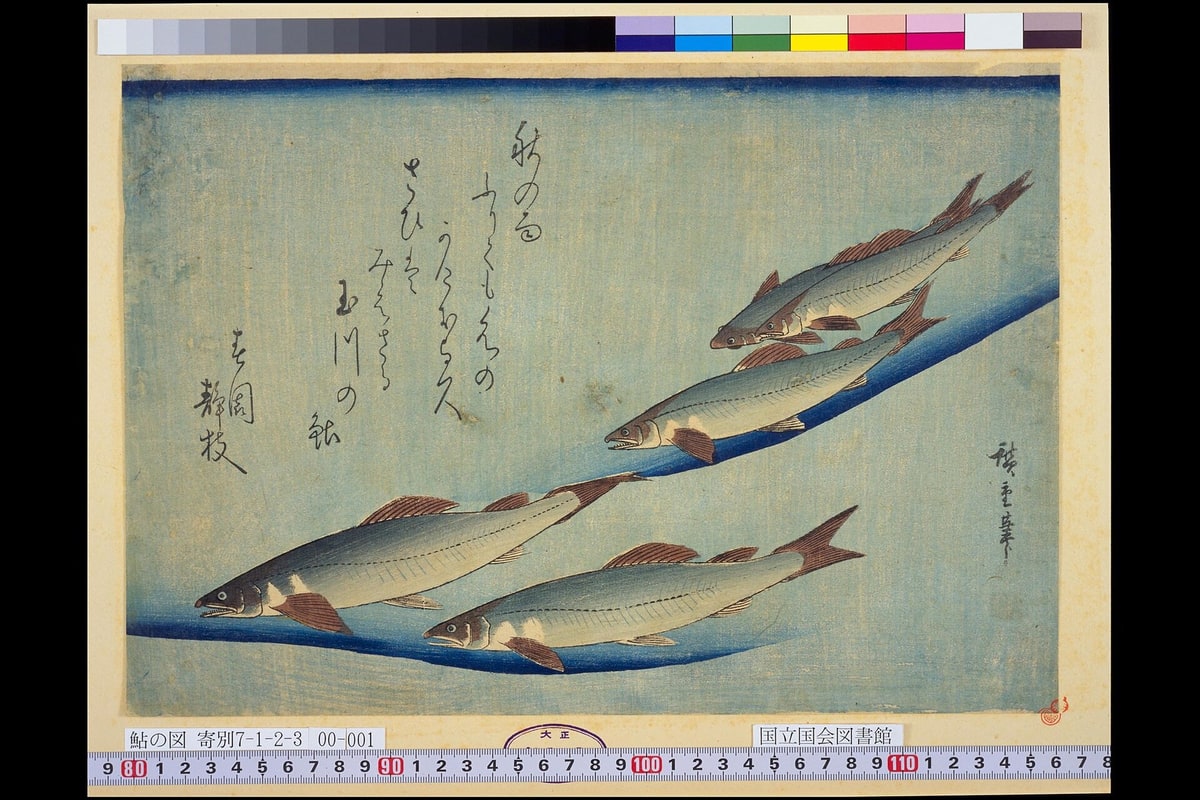
The yamabe is the same fish that the Kanto calls oikawa, the Kansai hai, and Kyushu hae. It lives in rivers throughout the country, and the male wears bright vertical bands in the spawning season. You cast a small fly on a slow run and take fish swimming near the surface: a light-handed sort of fishing.
The craft of the jointed rod is said to have begun in Kyoto. A haiku book of the Enpo era, early in the Edo period, cites the nested rod as a Kyoto thing. That is, at present, the oldest mention of a jointed rod that can be confirmed in writing; there is an oral tradition that the jointed rod was born in Kyoto in the late Heian period, further back again, but that cannot be verified. Edo's jointed rod begins with Taijiya Tosaku in 1788, and sixty years before that there were already rod shops in the streets of Kyoto making nested rods. Kyoto's rod shops have left no tidy, showy lineage of the kind Edo bamboo has, and I imagine many were quiet town shops passing from one generation to the next. I go to Kyoto meaning to see some trace of it with my own eyes, and each time Kyoto looks as though it will show me something and in the end sends me home having shown me nothing. So I go again the next year.
Now the tackle. What I take to the Kibune is a stream rod of about five metres, nylon of 0.8 for the main line, 0.4 for the tippet, and a few flies from a shop set of gnat patterns, chosen for the colour of the day's water. Plus a spare tip and a few floats. A rig that can be put together entirely from shop goods.
The rig of the bamboo era went like this. A jointed rod of four and a half ken if it came from a Kyoto shop, silkworm gut of one rin for the main line, silk for the dropper, home-tied flies wound in sea-bream red or in black, and a rakkyo float or a five-bu ball float. Gnat flies carried names that differed by district — Osome, Yatsuhashi, Yamigarasu — and there were anglers who could picture the colour and the winding from the name alone. There are photographic fly catalogues in the tackle shops now; in the old days the name preserved the culture. A name is itself a tool, one thinks at times like this.
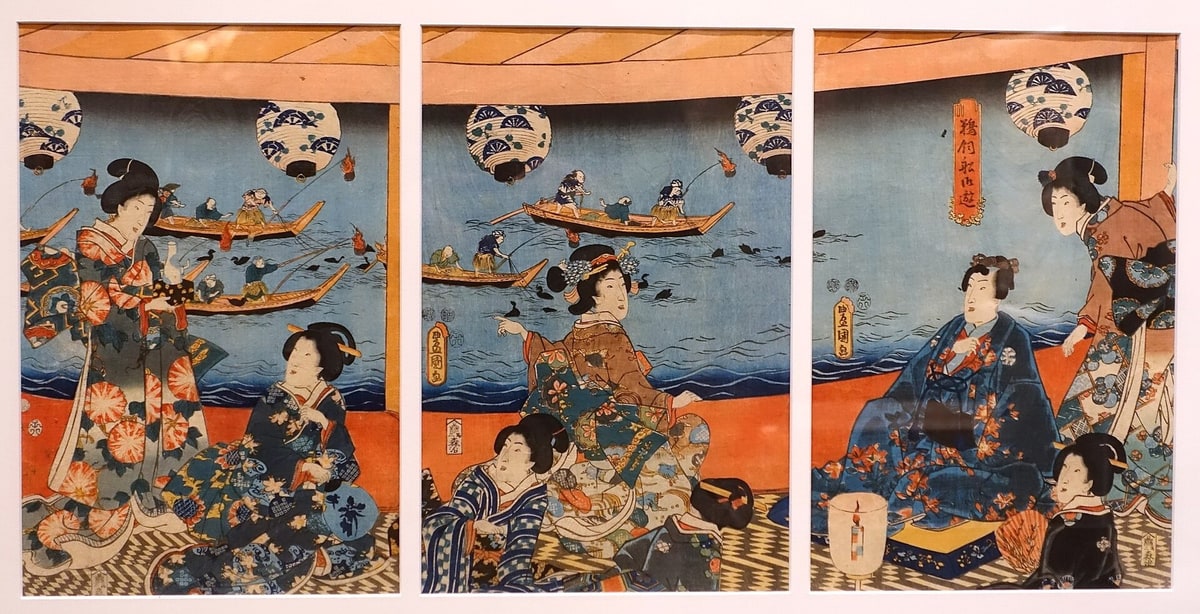
Utagawa Kunisada and Utagawa Kuniteru (public domain)
The bait — or rather, the matching of the fly's colour — is what matters. Against the colour of the water, whether the day's fly suits or does not suit makes the difference between heaven and earth. When it does not suit, nothing will make them take; when it does, they take so hard there is no time to change. This is called matching the hook. The whole savour of fly fishing for yamabe hangs on that one point. An angler carries dozens of flies and changes them against the day's water and sky.
Why is the rakkyo float shaped like a rakkyo. To make the fly dance. It raises a small ripple at the surface and makes the fly look like a real insect. That is what produces fish. A five-bu ball float will stand in for it, though there are anglers who say the rakkyo dances better. I have used both, and since it differs with the mood of the wind and the water that day, I have not been able to decide which is truly better.
The culture of the river platforms — the cooling platforms of the Kamo, the platforms of Kibune — is apart from fishing itself, but cannot be left out in speaking of Kyoto in May. To go up onto a platform on the way back and eat something with the sound of the river underneath. That is the manner of Kyoto in May. There are houses that will grill a yamabe you have brought in, and houses that serve the mountain food of Kyoto with no yamabe about it at all. Both are the Kyoto spring.
Once June comes the ayu season opens, and the anglers of Kyoto put out ayu rods on the Kamo and the Katsura all at once. Fly fishing for yamabe goes on in the gaps, but the leading part of the season passes to the ayu. I too begin about then to think of the next month. On the morning I leave Kyoto I walk through the morning mist at Kibune and cast once more before going home. With that, May closes.