On the food of Kyoto in May. Kyoto in May is a place where the reservations must go in before the fishing does. The platforms of the Kibune and the cooling platforms of the Kamo both open on the first of May and run to the end of September or mid-October, a seasonal trade, and locals and visitors alike book toward the opening day. The platform booking comes before the fishing arrangements. It seems to me the wrong way round, but that is apparently the Kyoto way, so that is how it goes. The record of the actual visit is added at the end of this piece.
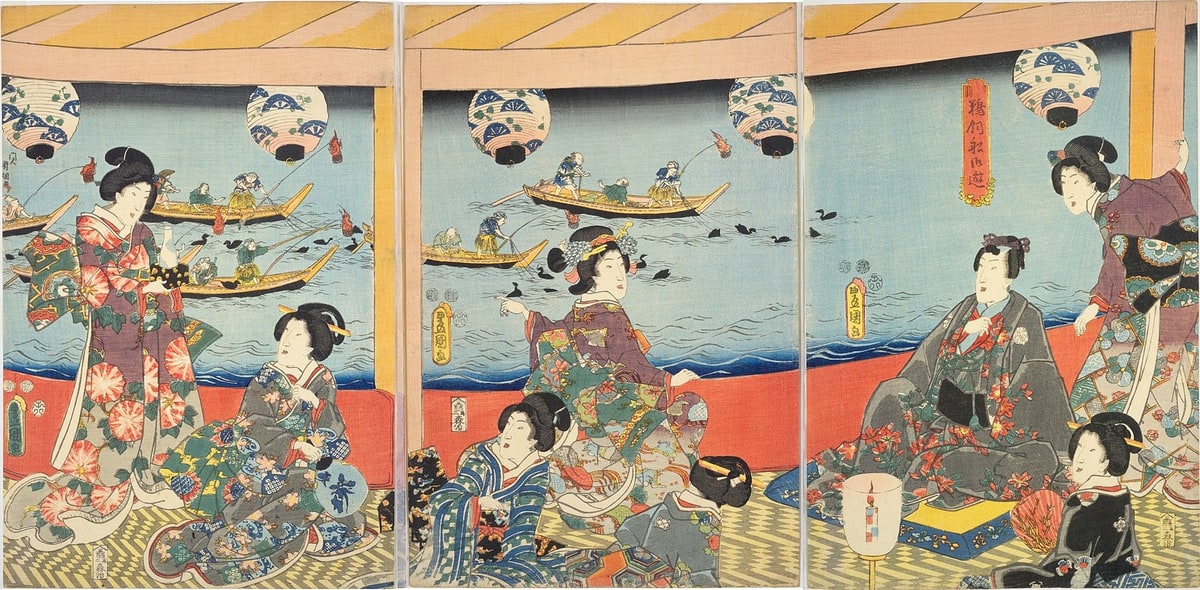
Utagawa Kunisada / National Diet Library (public domain)
About the River Platforms
There is one thing to say first. Both the Kibune platforms and the Kamo cooling platforms have their real object in the height of summer. The platform is a device for taking the cool, a game of using the cold sound of the Kibune's water and an air five degrees below the city as natural cooling against the sticky Kyoto summer. It began in the Taisho era when teahouses set benches out over the Kibune, and in Showa the cooking inns began to serve ayu on the platforms. So to enjoy a platform properly is to do it in the sticky height of July or August. May is the head of the season, still the early part of it. The new leaf is dazzling, but Kibune is in the mountains and cold, and there are days when sitting on a platform passes beyond cool into chilly. An angler goes up knowing that the early May platform is not the proper form. The platform cooking of ayu eaten in the proper heat is something to come back to Kyoto for after the June opening. Even so, May at Kibune has what belongs to May. New leaf, young ayu, mountain vegetables. That is May food, and cannot be had at the height of summer. Platform or no platform, one wants the mountain food of Kibune in the mouth once.
The Platforms of Kibune
The platforms of the Kibune are built by the cooking inns and teahouses that stand around Kibune Shrine, out over the river itself, from May to September, and the food is served there. Cold water runs directly beneath your feet, and you eat in that sound and the smell of new leaf. It is a Kyoto summer thing, and May is the head of the season.
Kibune Kiraku was founded in 1921 and stands facing Kibune Shrine. It has a hundred places on the platform, so a party will fit. Since I have no intention of going in a party, I note it for reference only. The cooking inn Ugenta traces its descent to the Ugenta family, hereditary shrine officers of Kibune. After the confiscations of the Meiji era they turned to forestry and to making horse-chestnut cakes, and the present form as a cooking inn dates only from after the war, in 1962. From a shrine family through a cake shop to a platform inn is a miniature of Kyoto's modern history, and reading the house's history alone made me want to go up once. As a platform it is middling in scale, and looks as though it would suit an angler travelling alone. The inn Hiroya was founded in 1932 and is more than ninety years old. Its platform lunch is popular. There is a tradition that Hiroya began the Kibune platform itself, so to trace the history of the platforms one should go there first. Its speciality is said to be ayu arranged as a stone garden, a dish that renders the Kibune river in salt and is a pleasure to look at. Ayu are still before their June opening, so in May it will be yamabe or young ayu grilled with salt on the list. Kibune Beniya is the largest, at two hundred places. Kibune Hyoe, Kibuneso and Kokon Fujiya have platforms as well. If an angler is to choose one house, I have narrowed my provisional choice to the middling Ugenta or to Hiroya, known for the stone-garden ayu. Unable to settle it, I intend to decide by the weather on the day.
The Cooling Platforms of the Kamo
Come down from Kibune into the city and there are the cooling platforms of the Kamo. Restaurants stand in the Pontocho quarter, and from the first of May to the fifteenth of October they put platforms out over the river. Pontocho Robin uses a Kyoto townhouse of a hundred and fifty years, and its head cook chooses the material at the market each day. Hamo in a sukiyaki, an assortment of that day's fish. Hamo comes into its own from June, so in May it is the early ones. Ushinohone, founded in 1985, serves inventive Japanese food. Its founding is not so old, but it is described as continuing to be loved by the people of Kyoto. Kaiseki with the season's material, listening to the water under the platform. Nagamegawa Pontocho Hana serves kaiseki with yuba and fresh wheat gluten, and hotpots of seasonal material. The platform is available May to October. Many other houses belong to the Pontocho guild, and the correct way to walk Pontocho seems to be to pass through on the way back from fishing, look at the curtains, and choose. I have no experience of the correct way. However many times I visit Kyoto, this is the part that will not take.
A house that would cook a yamabe or whatever one has caught would be ideal, but at both the Kibune and the Kamo platforms the list is chiefly a set kaiseki arranged in advance, and whether one may bring in a fish is up to the house. Worth confirming beforehand. To have a May fish from the Kibune grilled with salt on the platform would be the proper form, and failing that one takes the house's young ayu. Early hamo is the emblem of the Kyoto summer; the real season is from June, but the early ones have their own refinement. Because Kibune is in the mountains, mountain vegetables come out: bracken, royal fern, kinome, angelica shoots. A taste of the mountain always comes in as a starter to the platform kaiseki. Fresh gluten and yuba are pillars of Kyoto food and appear almost without fail in a cooling-platform kaiseki. A measure or two of cold local sake — Gekkeikan, Tamanohikari, Shinsei, Eikun, from Fushimi — drunk on the platform with the water sounding below. At a house like Kokon Fujiya, going down to the platform for a matcha soft-serve is not a bad idea either.
The Plan for a Day
Here is a day of yamabe fishing in Kyoto in May, laid out. In the morning, get off at Kibuneguchi and walk up to the upper Kibune. Put out a rod from about below Kibune Shrine. To cast a fly in that new leaf is worth the day on its own. Whether anything comes hardly matters. At midday, walk back down to the village and go up to a house doing a platform lunch. Hiroya, or Ugenta, by that day's booking and mood. On the platform, young ayu grilled with salt, a starter of Kyoto mountain vegetables, and a cold beer. There is fishing to come, so the drink is held back here too. In the afternoon, go back upstream and fish until near evening. When the light drops, put the rod away and take the train down into the city. At night, go up to a cooling platform in Pontocho. Robin, or Ushinohone, again by that day's booking. Early hamo, a kaiseki of Kyoto vegetables, a measure of cold Fushimi sake. With the Kamo sounding under the platform, one confirms the entrance to a Kyoto summer. Next morning, get up slowly at the inn, and on the way to the station stop at a Fushimi brewery and buy a small bottle to take home. With that, Kyoto in May closes.
Kyoto is a place where everything is settled by the booking, and an angler like me, who leaves it to the last, has trouble every year. Every year I declare I will book early, and every year I am late. On this point I have given up on improving myself.