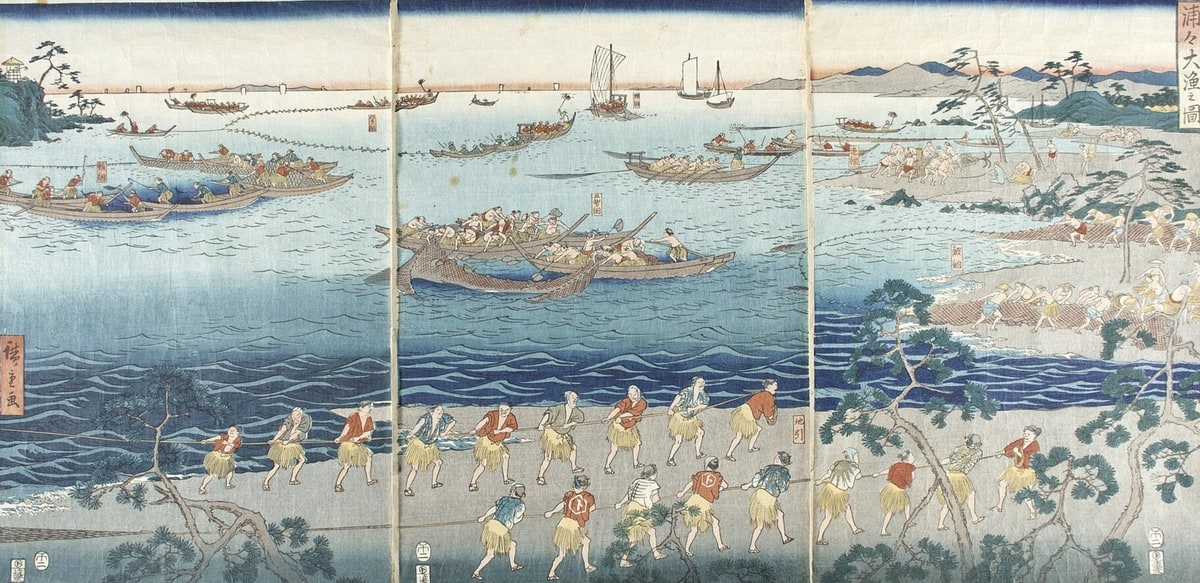
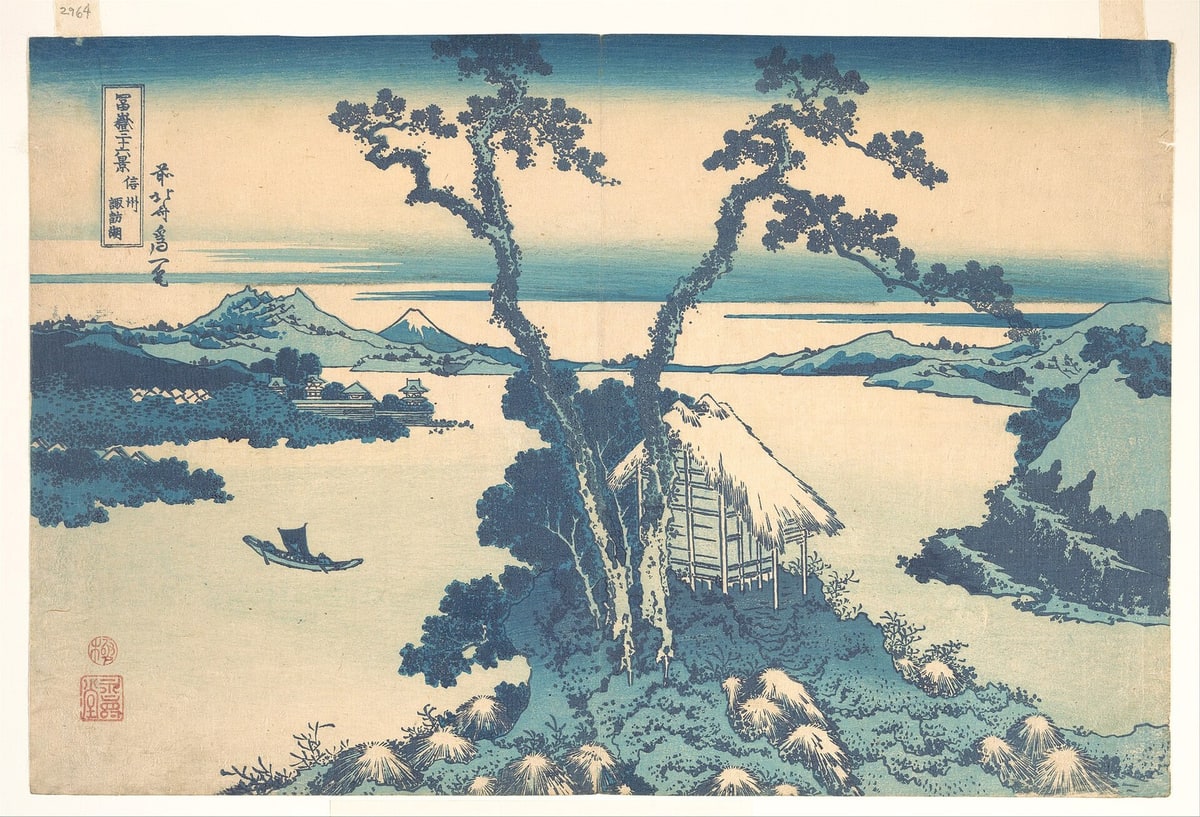
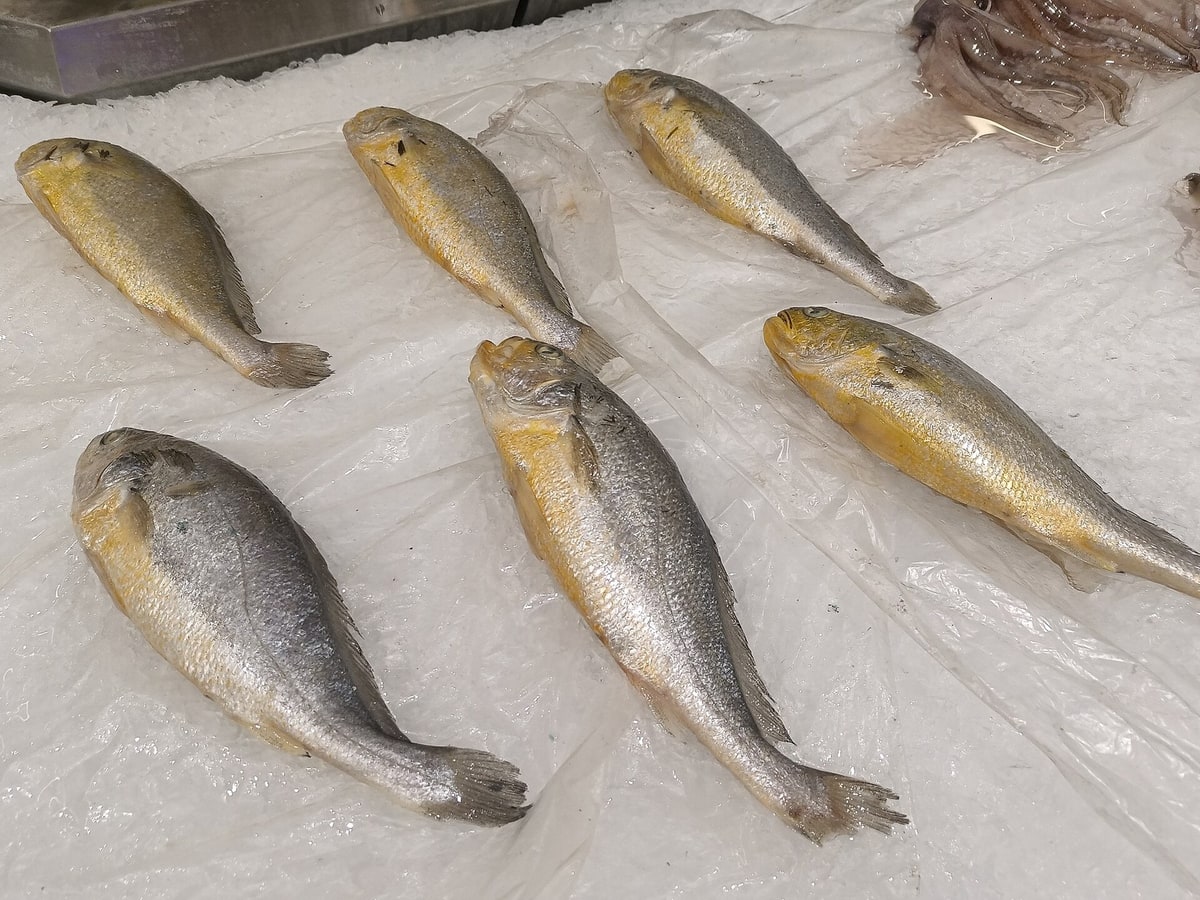
On the food of February. What you take in February, you cannot eat. Because of the state of the waters where they live, the manner now is to put a tanago back as soon as possible. Up to the war a shop near Ryogoku Bridge is said to have made its name on tanago yakiju, but that cannot be imitated today. So the fishing is finished as a ceremony of gestures, and the eating is switched to another object: that two-part arrangement is the February angler's way. The record of the actual visit is added at the end of this piece.
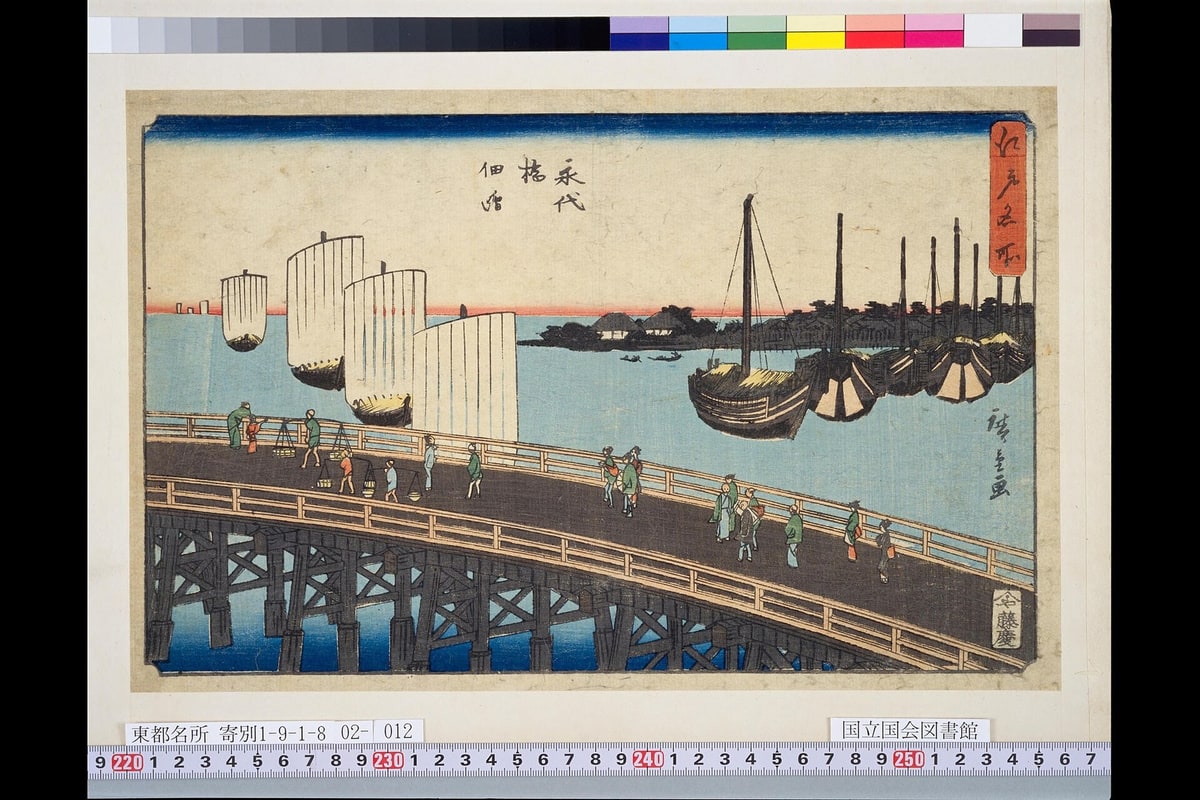
Utagawa Hiroshige / National Diet Library (public domain)
The Tsukudani Shops
Fortunately several shops of preserved fish that have run since the Edo period still stand around the winter fishing grounds. They do not sell tanago, but the technique itself — small fish boiled in salt, then reduced in soy — is an Edo invention, and there are houses that have kept it a hundred and fifty years and more. To look in at one such shop on the way back from taking a tanago: that is what makes sense as February's arrangement for food.
A little on the origin of tsukudani. In 1858 a pedlar named Saisuke Aoyagi sold the salt-boiled small fish of the Tsukudajima fishermen at Inari Shindo in Nihonbashi Gofukucho, calling it tsukudani, and that is taken as the beginning of the name. Techniques for reducing small fish to keep them existed before, but they were boiled in salt. In 1862 Funasa, founded at Asakusa Kawaracho, now Asakusabashi in Taito ward, brought in the fresh idea of reducing in soy rather than salt, and that became the model for tsukudani as it is. Funasa's is still not the generally sweet-salt tsukudani but a dry Edo-front taste that draws the flavour out of the material. I bought some once and took it home, and the moment it went onto white rice I understood it was a different thing from the sweet kind one buys at a counter. What Edo-front means was something I first grasped through tsukudani.
Besides Funasa, shops surviving from the Edo period include Tanakaya (1837), Tenyasu (1843), Tsukumo (1856), Marukyu (1859) and Ariakeya (1861). From about the winter fishing grounds one or another comes within range. Tsukudajima, Asakusabashi, Nihonbashi. All of them lie along roads anglers walked in the days of Edo.
If instead of a shop you want to sit and be served river fish, several houses remain about Ryogoku and Asakusa. Ryogoku Dozeu Kikyoya, a river-fish house founded in 1933, sets out loach, eel and catfish. It keeps the food of Edo seriously, and one can arrange to walk from Honjo to Ryogoku on the way back from the cold and go in under the curtain. From Honjo Taiheicho to Ryogoku is perhaps forty minutes by night. You warm a body chilled at the water by walking it to the shop. Look along the old houses of Ryogoku and the Edo-front lineage is still there: chanko, loach, eel, river fish, preserved fish. To eat something that will pass as the food of Edo on the way back from tanago fishing is a fitting way for a February angler to close.
What to Eat
Since the tanago is not eaten, February’s object becomes the cold-season fish of the Edo front and the preserved small fry. Set them out one at a time.
Tsukudani. On the way home you stop and have two or three kinds packed at Funasa, or Tanakaya, or Tenyasu, or Marukyu. Clams, prawns, whitebait, small gobies. I would like to ask whether they have tanago, but since I know they do not, I do not ask. Not asking is also one of an angler’s manners.
Yanagawa. Loach in the cold is firm and suits the pot, simmered with shaved burdock and egg. At a house like Kikyoya in Ryogoku, on a cold night, with warmed sake.
Eel. Edo-front eel has been said since long ago to be best in the cold: the fat is on it, and yet it is not oppressive as summer eel is. A skewer at an eel house in Ryogoku or Asakusa.
Catfish. Houses that serve it are rare now, but at a river-fish house one may come across it in winter, as tempura or simmered. I have not yet eaten catfish, and would like to try it once while it is cold.
The cold-sea fish. Flounder, winter yellowtail, the fin meat of the flounder. This is the season in which an Edo-front sushi counter shows what it is worth. Going up to a counter on the back of tanago fishing is a little off the line, but if you want the cold fish in your mouth, it holds together.
Say one has taken a tanago somewhere in the Kanto. Here is the day.
In the morning, before going to the water, leave early and stop at Funasa in Asakusabashi as it opens. Put in an order for two or three kinds of tsukudani, to be collected afterwards. This is a fantasy; in practice it would turn into a telephone order or a parcel.
At midday, rice balls at the water. Tanago in the cold come best from morning to early afternoon, so one does not press on late.
In the evening, break camp and go back to Asakusabashi. Collect the tsukudani and take it home as a present.
At night, walk to Ryogoku and go up to Kikyoya, or somewhere lighter that serves river fish. Order the loach yanagawa or grilled eel, and a measure of warmed sake. In the room on a cold night, it is about when the first cup has gone round that the chill of the water finally leaves you. Without this, February’s fishing ends unfinished.
In place of eating the tanago, one eats the preserved food and the river-fish cooking of the Edo front. In place of being satisfied by looking at its colour, one scoops up the food of Edo entire. This is what I have settled on as February's way.