TABI Series · Part 1 of 3 — a three-part record where the disclosure deepens, piece by piece.
There is a stance the Edo-era anglers called kiiki. The angler does not look as though he is going to fish. He walks out of the house casually. The rod is broken down into many short sections and hidden in a sleeve pocket. The gear does not show. If you meet an acquaintance on the way, you do not say you are going fishing. Coming back, the same — caught or not caught, no sign on the face. The craft and the pride lean not toward displaying the tools but toward making them disappear. The many-piece ferrule discipline of the Edo wazao was sharpened in pair with this stance. Make the rod inconspicuous. Do not let it be felt.
TABI is a rod that pushes that stance all the way to the bottom of the travel bag. I designed it; call me eccentric and I will not protest. I wanted a rod to take with me on a trip — not a rod for going fishing, but a rod tucked among the luggage. If I happened to find water, I would take it out. I might not take it out. The mere fact that a rod sat at the bottom of the bag would change the color of the trip a little. I had carried this idea for years: a bamboo rod that does exactly that.
Behind the idea is a regret from a single trip. I had stayed by the water. In the morning, from the window of the room, I could see fish rising on the surface of the river. If only there were a rod I could carry, I thought, right then. By the next day I was in a different town, and that morning was never coming back. A rod that fits in the bag would save mornings like that. But a rod carried in luggage has to be small. The largest size allowed by a travel bag is, perhaps, the inside of a pocket. Working backwards from there, I arrived at the size of a passport.
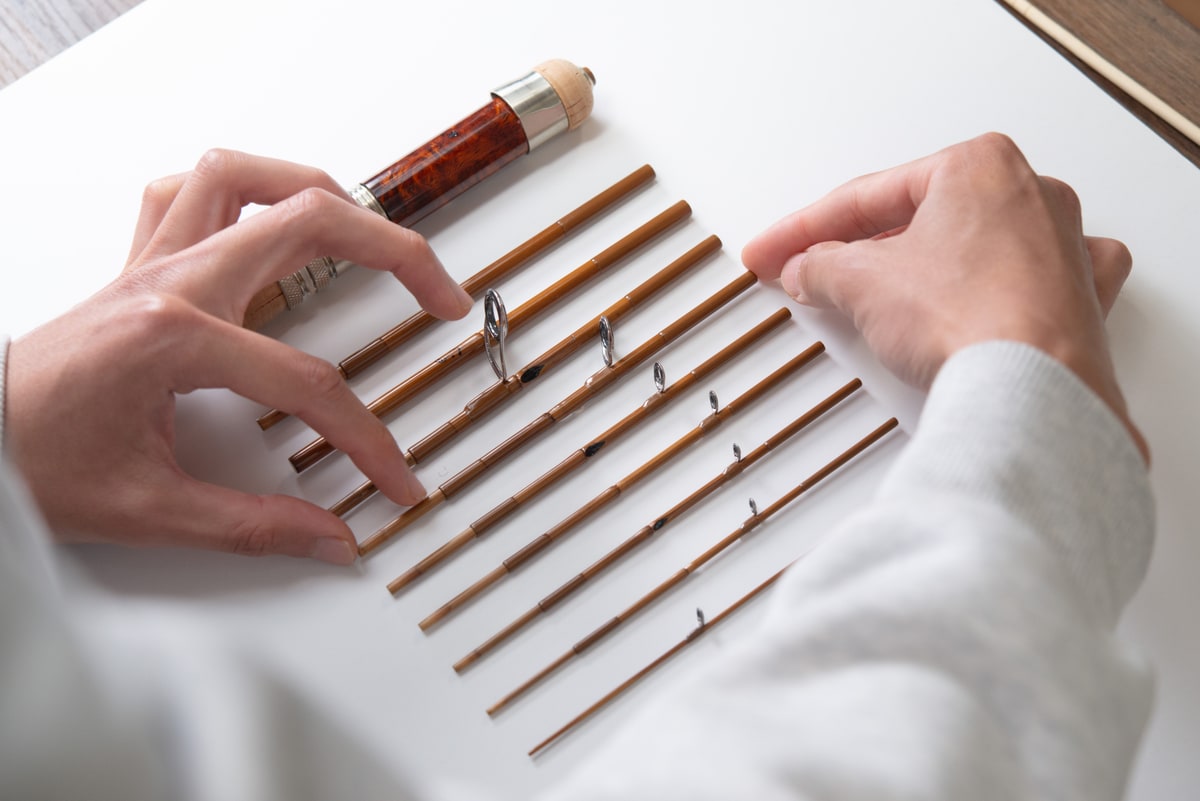
The Edo wazao has a technique called inrou-tsugi — an internal sleeve ferrule. A slim core of bamboo is set inside the joint, and the male and female sections clasp through this core. To stow, each section is slipped into the wider one above it, in order from the tip. Like nesting dolls, the rod disappears inside itself. Push this technique to its limit, and a bamboo rod with a stowed length of roughly twenty centimeters becomes possible in principle. The size of a passport. The Edo wazao's many-piece ferrule was, from the start, a discipline pursued for portability — many-piece rods for crucian carp, for goby, all worked toward a shorter stowed length. This rod sits on the extension of that line. People could see it could be made; no one had made it. The distance between "visible" and "made" is the maker's hand, and the patience of someone willing to wait for it.
I brought the idea to a skilled Edo wazao maker. At first it was a rod for myself. We started with a nami-tsugi (sleeve-over) ferrule and built a prototype to that point. But for a rod this small, sleeve-over kept loosening; each cast had a faint air of slipping at the joints. We changed direction to inrou-tsugi, and that air vanished. Each time the cores met, the bamboo gave a small, soft click and seated home. From the box, a twenty-centimeter object emerges and unfolds into a five-foot rod. I have not tired of joining it together.
I took it to the water once. I cast a small spoon, and the body of the bamboo curved slowly and returned, and the spoon traced an arc and landed. That a rod this short can throw a lure at all is, first of all, a pleasure. When a trout took, the whole body of the rod absorbed the load — hard work, but not unmanageable. The way the bamboo bends and absorbs the fish's run is something a carbon rod does not give. The fish's movement reaches the palm directly through the rod. About handling that fish on a rod pulled out of a bag, I will not be too pleased with myself.
Because I designed it as a rod for travel, I named it for travel. Tabi. I considered no other name. After I started carrying it, when picking a destination, whether a river was nearby began to faintly weigh on the choice. The way one looks at a map changes. The criteria for picking a lodging quietly gain "distance to water." Sometimes I think of northern mountain streams; sometimes my heart bends to a southern brackish water. Because the rod's range is limited, the destinations narrow naturally, and choosing becomes easier.
I am also thinking about a box. I cannot just toss the rod into a bag, so I am imagining commissioning an Edo cabinetmaker to make a burlwood case to fit. To commission a case for a rod is, as far as gear goes, a slightly excessive piece of staging — but for a rod taken on a trip, that kind of excess suits.
I rest TABI in my palm. It has a real, settled weight. Holding it, I want to go somewhere. Even without a trip planned, the feeling comes. The destination need not be decided. Just put the rod in the bag, and figure out the rest after leaving.