TABI Series · Part 3 of 3 — a three-part record where the disclosure deepens, piece by piece. The full origin is revealed here.
In my hand is an Abercrombie & Fitch Passport Rod. Burgundy fiberglass, a six-inch cork grip, broken down into ten pieces it slips neatly into a box about six and a half inches long. Next to it, the pages of the catalog. Next to that, a freshly finished bamboo rod. The bamboo one is TABI; I designed it. Call me eccentric and I will not protest. From the day I first held the Passport Rod, the idea of making this in Edo wazao kept its place in me.
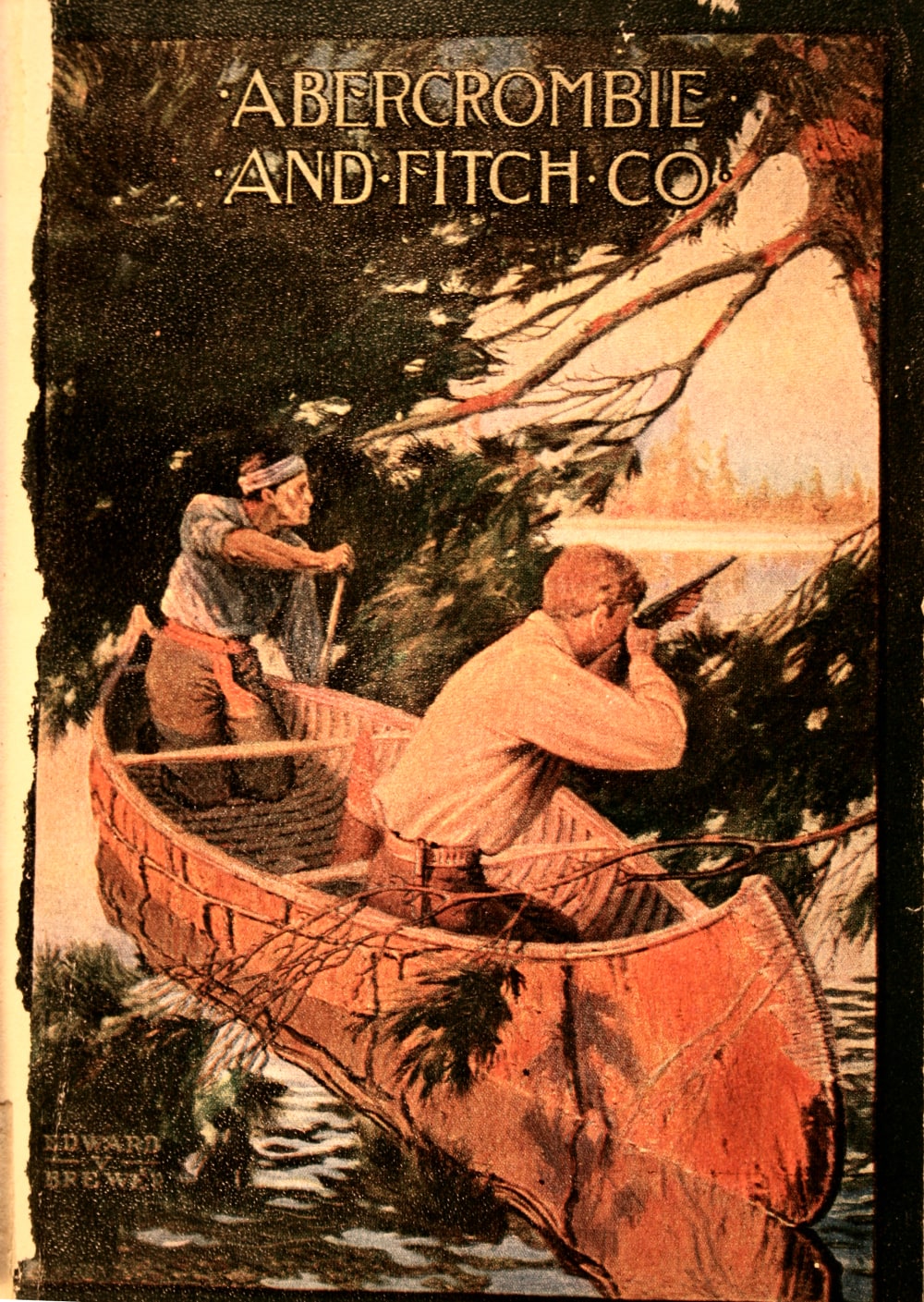
Abercrombie & Fitch of the 1960s was, in the world today, an utterly different thing. The New York flagship held a shooting range in the basement and big-game trophies on each floor — a general store of adventure and travel that dressed explorers' expeditions, picked rods for gentlemen heading to European salmon rivers, and arranged the entire kit for a transatlantic crossing. Fishing was an extension of upper-class club culture, part of the social rounds of gentlemen. In that era, a rod that fits in the same bag as a passport was planned. The catalog announces it as fitting in a vest pocket, with the names of three branches — New York, Short Hills, Chicago — set beside the description.
What strikes me most in the Passport Rod's provenance is where the name Charles C. Ritz appears. Proprietor of the Hotel Ritz in Paris, and a master of fly casting. In 1927, while repairing a broken rod, he chanced upon a taper that softened the tip and butt and tensioned the middle; six years later he named this parabolic action. In 1958 he founded an international fly fishing club in Paris, where, in front of members gathered from around the world, he is said to have drawn a fly line into an arc on the terrace of the hotel bar. The rod in his hand on that occasion was this Passport Rod. A rod born in a New York store arrives at the most glamorous corner of Paris. The transatlantic traffic of fly fishing culture crossed on top of this small rod. I lift the Passport Rod in my hand; the one-and-six ounces of weight rest at my wrist. Whether this rod ever touched the air of Paris, I do not know — but it is more pleasing to imagine that it did.
The maker of the Passport Rod was Phillipson Rod Company of Denver, Colorado. A workshop that pioneered fiberglass rods, its deeper source lies in the so-called Banty Rod — short rods used in the steep mountain streams of the American West, by anglers chasing trout up sharp gradients. For the carry, shortness and many-piece ferrule had practical meaning. By the time that idea was redressed as a travel item, the mountain smell was gone, and it had become a luxury kept inside a leather case. The catalog shows two kinds of boxes: a paper box with gold trim, and a sturdier suede leather travel set that includes a reel. Either way, they sit closer to gifts than to fishing tackle.
The reason I wanted to make this in Edo wazao was that I sensed a shared spine in the many-piece ferrule tradition. The Edo wazao's inrou-tsugi sets a slim core inside each joint and clasps the male and female sections through it. With that technique, a passport-size bamboo rod is, in principle, possible. I handed an A&F Passport Rod to a skilled Edo wazao maker and asked whether it could be made in bamboo. That is how this began. At first we got as far as a sleeve-over (nami-tsugi) prototype, but for a rod this small the sleeve-over kept loosening at the joints, and we changed direction to inrou-tsugi. Across a sixty-year gap, bamboo answered.
I lay TABI beside the Passport Rod and look at them together. Stowed, they are nearly the same size; assembled, about five feet. They handle small lures up to three grams, and trout around thirty centimeters. Lift the Passport Rod and there is the candid feel of a uniform industrial product. Lift TABI and a faint texture of nodes meets the fingers. Two rods that set out from the same idea, with different materials, different times, and different craft traditions, sit side by side here.
In Edo wazao there is an aesthetic called koiki — quiet style. The angler does not look as though he is going to fish. He walks out of the house casually, fishes, and comes back. TABI extends that stance further: a rod tucked into a bag without deciding whether you will fish at all. You bring it on a trip. If you feel like it, you take it out. If not, not. The mere fact that the rod is in the bag changes the air of the trip.
I am thinking about a case as well. The A&F Passport Rod came in a paper case with gold trim. Inspired by that elegant air, I am considering commissioning an Edo cabinetmaker to make a burlwood case for TABI. To commission a case for a rod is, as far as gear goes, a slightly excessive piece of staging — but for a rod taken on a trip, that kind of excess suits.
I rest TABI in my palm. It has a real, settled weight. Holding it, I want to go somewhere. Even without a trip planned, the feeling comes. The destination need not be decided. Just put the rod in the bag, and figure out the rest after leaving.